Language
 EN
 ES
 RU
 DE
 EL
 IT
 JA
 KO
 PT
 ID
 SR
 UK
 VI
 TH
 TR
 MS
 BE
 AR
How to Test a New Energy Vehicle A/C Compressor Before Refitting
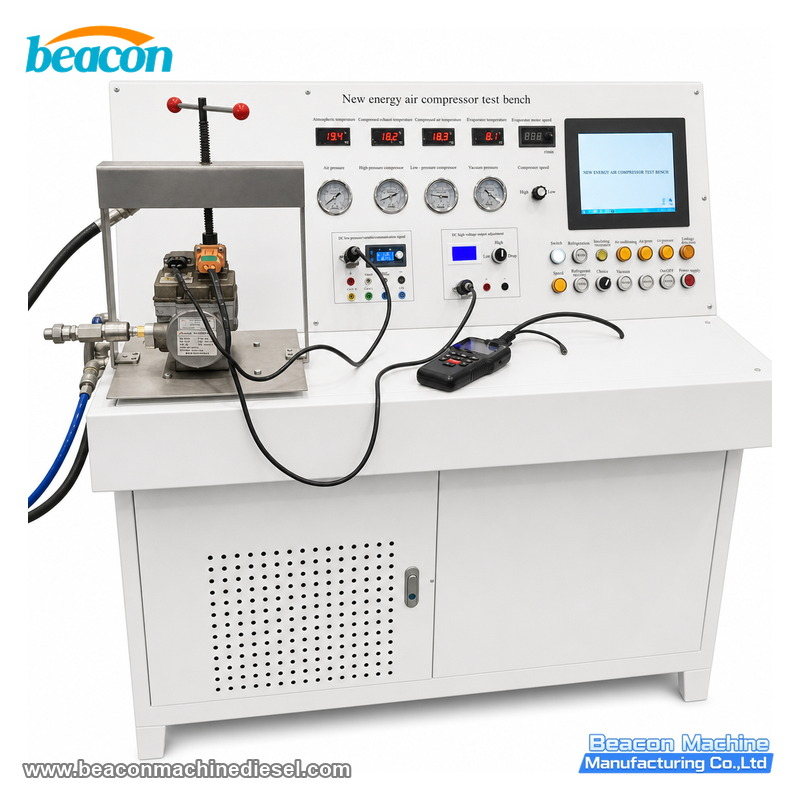
One in four cars sold worldwide in 2025 was electric, and more than 20 million new electric cars left showrooms in a single year. Every one of them carries an electric air-conditioning compressor that runs on the high-voltage bus, is commanded over CAN or LIN, and costs real money when it fails. This guide covers how those compressors fail, what a bench has to measure to prove a fault, and where a workshop saves time by testing before the vehicle is reassembled.
Why an NEV compressor fails in ways a pressure gauge cannot show
A belt-driven compressor on a combustion engine is a mechanical device with a clutch. An electric compressor is a mechanical device plus a power inverter plus a controller plus a network node, all inside one housing. When it stops cooling, the cause can sit in any of those four layers, and the symptom looks identical from the driver's seat.
The compressor is also a high-voltage component. On a 350 V or 800 V platform the inverter switches several hundred volts at high frequency, so an insulation defect that would be harmless on a 12 V accessory can put the vehicle into a safe-state shutdown. That is exactly the kind of fault a shop cannot find by watching vent temperature.
Four failure patterns that reach the bench
Insulation breakdown. Moisture ingress, oil contamination or winding degradation drops the resistance between the high-voltage terminals and the housing. The HVAC controller logs an isolation fault and refuses to run the compressor, often with no cooling symptom at all before the event.
Inverter or controller failure. The power stage stops switching, or the controller stops answering on the bus. The compressor may spin freely by hand and still be dead electrically.
Mechanical seizure or wear. Scroll and rotary compressors seize after oil starvation, liquid slugging or long storage. Mechanical damage usually contaminates the circuit with debris, which then damages the replacement unit.
Refrigerant or oil problems. Undercharge, overcharge, non-condensable gas or the wrong oil all show up as poor performance. A compressor condemned for low performance is sometimes a system problem wearing a compressor part number.
What the vehicle can and cannot tell you
Vehicle-level diagnosis answers one question well: does this compressor work in this car, in this ambient, on this charge? It answers almost nothing else, because the test is not repeatable. Ambient temperature drifts, the charge is unknown, the compressor only runs when the controller allows it, and a fault that appears at 4 000 rpm and 18 bar may never appear at idle in the bay.
| Question | On the vehicle | On a test bench |
|---|---|---|
| Is the insulation still in specification? | Requires disconnecting the HV circuit and a separate megohm test | Measured as part of every run, before power is applied |
| Does it respond to a speed command? | Only when the HVAC controller decides to send one | Command sent directly over enable, CAN or LIN |
| How much pressure does it build at a known speed? | Depends on ambient, charge and condenser condition | Repeatable at a set speed and a controlled circuit |
| Is the current draw normal? | Hard to separate from other loads | Read directly from the DC supply |
| Can a repaired unit be signed off? | Only by refitting and hoping | With a recorded test result per unit |
The five measurements that decide good or bad
DC input current at two or three fixed speeds, compared with the value for that compressor family
Discharge pressure rise and suction pressure at those speeds
Temperature rise across the compressor, which exposes internal leakage faster than pressure alone
Insulation resistance from the HV terminals to the housing
Response to the speed command itself: does the compressor follow the ramp, or drop out mid ramp
Two test modes, two different jobs
A dry air test is the fast screen. The compressor is driven against air, so pressure builds without any refrigerant in the circuit. It confirms the mechanical and electrical health of the unit in minutes, with no recovery machine and no refrigerant handling.
A refrigerant circuit test is the realistic one. The compressor runs against a real charge with vacuum and recovery available, so the result reflects how the unit behaves inside an actual air-conditioning loop, including the pressure ratios and temperatures it will see in service.
What to look for when specifying a bench
DC range and current. The supply must cover the platform voltages you service and the starting current of the largest compressor you expect.
Control interfaces. Enable, CAN and LIN, because a compressor that cannot be commanded cannot be tested.
Pre-charge and discharge. A bench that steps 650 V onto a capacitive load without a staged pre-charge is a component killer. Self-discharge after power loss is a safety requirement, not a feature.
Pressure instrumentation on both sides. High side, low side and vacuum, read at the same moment as the electrical values.
Recorded results. A number on a screen is a test. A stored result per serial number is a warranty defence.
Where the NC101 fits
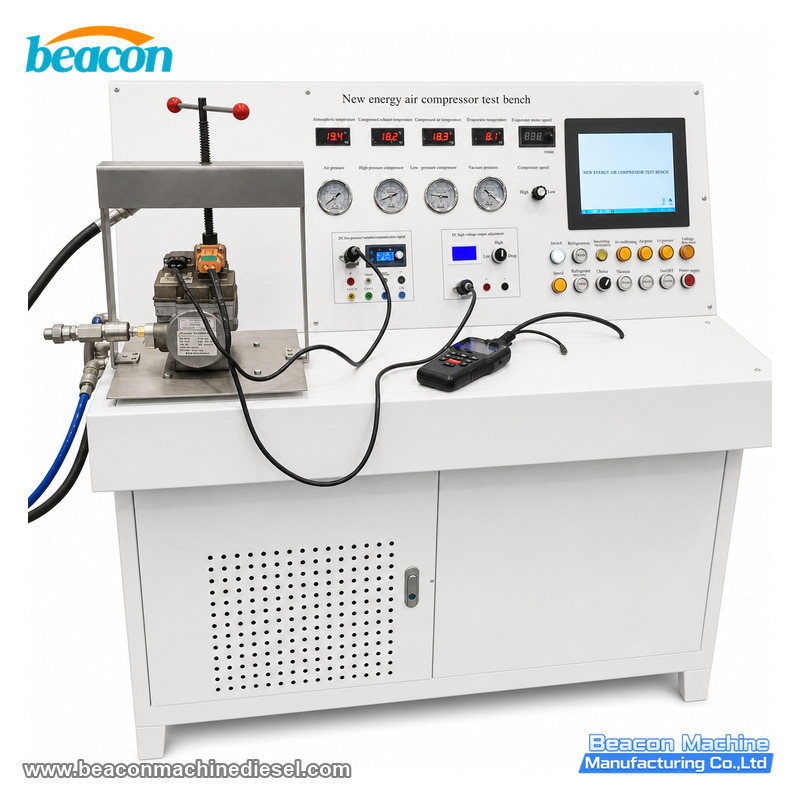
The NC101 new energy vehicle air conditioning compressor test bench was built around exactly these requirements: a 0-650 V / 30 A DC supply with two-stage pre-charge and automatic discharge, a 0-30 V / 25 A auxiliary output for control electronics, enable, CAN and LIN start, 5 MOhm insulation detection, and both air and refrigerant test modes in one cabinet. For a workshop it means a compressor can be condemned or released on measured numbers before it goes back on the vehicle, instead of on a road test and a hope.
A 20 minute routine that pays for itself
Record the unit serial number and the vehicle it came from.
Insulation check before any power is applied. Fail means stop.
Dry air run at three speeds: current, discharge pressure, temperature rise.
Compare against the reference values for that compressor family.
If the unit passes and the complaint was poor cooling, move to the refrigerant circuit test with vacuum and a known charge.
Record the result, sign the job card, and keep the file with the serial number.
Takeaway
An electric compressor is a high-voltage assembly with an inverter, a controller and a network interface, so the diagnosis has to cover electrical integrity, control response and mechanical performance at the same time. A bench does that in one pass, at a fixed speed and a known circuit, and leaves a record behind. On a vehicle, the same question takes a disassembly, a charge and a test drive, and still ends in an opinion.
Related products
We'll get in touch with you via WhatsApp or email in 12 hours.
about beacon
PRODUCTS
contact us
TEL: 0086-13375386297
WhatsApp:+86-13375386297
Email: jamesjing@beacon-machine.com
Add: High Technology Industrial Park of Taian city,Shandong province,China